Who Gets the Family Pets in an Illinois Divorce?
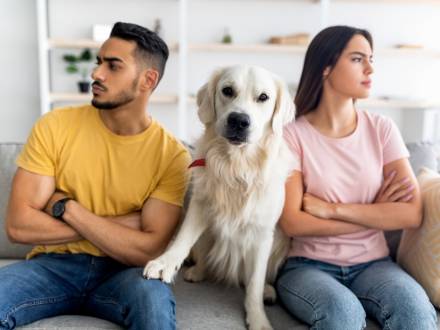
In an Illinois divorce, either spouse can receive ownership of a family pet. The court can also allow both spouses to share responsibility. The decision depends on whether the animal is marital property and what arrangement supports its well-being.
Spouses can also reach their own agreement about who keeps the pet. If you are going through a divorce in 2026, our Plainfield, IL divorce lawyers can explain your rights and help you protect your relationship with your pet.
How Does Illinois Law Decide Who Gets a Pet in a Divorce?
The law governing pets in an Illinois divorce appears in 750 ILCS 5/503, which covers the division of marital property. Under this law, if a companion animal is marital property, the court must decide who will own and care for it. When doing so, the court must also consider the animal's well-being.
Unlike children, pets are treated as property under Illinois divorce law. If a pet is marital property, the judge must consider its well-being when deciding who gets it. This rule does not apply to service animals.
Is Your Pet Considered Marital or Non-Marital Property in Illinois?
Marital property usually includes things either spouse acquires during the marriage. The court divides this property between the spouses during a divorce. If your pet is marital property, the judge must also consider its well-being. A pet acquired during the marriage is generally marital property, regardless of whose name appears on adoption paperwork or who paid the adoption fee.
A pet one spouse owned before the marriage is typically non-marital property and stays with that spouse. The same applies to an animal received as a gift to one spouse individually or acquired by inheritance.
For example, if you adopted a dog before getting married, the dog would usually remain yours after divorce. Your spouse does not gain ownership simply by helping feed, train, or care for the animal. However, certain changes in ownership can affect whether the pet remains separate property.
Adoption records, veterinary files, microchip registration, licensing records, and receipts all help establish when the pet was acquired and who owns it.
What Does an Illinois Divorce Court Consider When Deciding Who Gets a Pet?
Illinois does not define well-being in the statute. It leaves judges room to consider the animal's needs and living situation. Factors that can help a court decide include:
-
Who feeds, walks, grooms, and exercises the animal day to day
-
Who takes the animal to veterinary appointments and manages its care
-
Which spouse has a home and schedule that accommodates the animal
-
Whether the animal is bonded to children who will live primarily with one parent
-
Whether either spouse has a history of neglecting or mistreating the animal
-
Which arrangement gives the animal a stable home and a familiar routine
-
Whether one spouse can afford the ongoing costs of food, care, and medical needs
-
Whether a yard, housing situation, or lease restriction affects the animal
These are possible considerations, not a required checklist under Illinois divorce law. Veterinary records can show who took the pet to appointments. Photographs and receipts for grooming or boarding can also help show who cared for the animal. Neighbors or dog walkers can provide statements about who handled the pet's daily needs.
Can You Share Ownership of a Pet After an Illinois Divorce?
Illinois permits joint ownership and responsibility, so spouses can share care of their pet after divorce. However, joint ownership does not guarantee a particular visitation schedule. A shared arrangement can address a schedule for the animal's time. It can also cover how veterinary costs and food are divided, who makes medical decisions, and what happens if one person relocates.
Whether sharing works depends on the people involved. Both spouses need to cooperate and make decisions about the animal's care. Disagreements over schedules or expenses can make shared arrangements difficult.
Sharing Companion Animals After Divorce
Illinois also allows courts to address companion animals in temporary orders while a divorce is pending. Either spouse can request temporary sole or joint possession of a pet they jointly own.
Many couples reach an agreement without asking a judge to decide. Spouses can make a written agreement about pet ownership and responsibility. An agreement can address feeding schedules, medical expenses, travel, and what happens if one spouse can no longer care for the animal.
Schedule a Free Consultation With Our Will County, IL Divorce Attorneys
At Reeder & Brown, P.C., we built the practice around honesty, integrity, and treating people well. Our attorneys understand that family pets are important parts of people's lives. We can help you understand how Illinois law applies to your pet and work toward a fair arrangement.
Our attorneys bring over 30 years of combined experience, including thousands of cases handled as prosecutors and defense attorneys. We use that courtroom experience to represent clients in contested family law matters.
Contact Reeder & Brown, P.C. at 815-885-5980 to talk to our Plainfield, IL divorce lawyers today.

Fill out the form below to schedule a consultation.
 The use of the Internet or this form for communication with the firm or any individual member of the firm does not establish an attorney-client relationship. Confidential or time-sensitive information should not be sent through this form.
I have read and understand the Disclaimer and Privacy Policy.


From our office in Joliet, Illinois we serve the communities of Plainfield, Lockport, Crest Hill, New Lenox, Mokena, Romeoville, Homer Glen, Bolingbrook, Naperville, Aurora and Will County.
Results listed are not a guarantee or indication of future case results.
58 North Chicago Street, Suite 404, Joliet, IL 60432815-885-5980